GGUM Ideal Point Estimates for Congresses 100-119
GGUM-based ideal point estimates for every member of the US House and Senate, 100th through 119th Congresses (1987 to the current session). Forty chamber-level fits, each paired with Voteview member metadata so each file merges directly into existing W-NOMINATE workflows.
The data
Each row below is one Congress, newest first, with the House on the left and the Senate on the right. Clicking a tile opens that chamber’s detail page — scatter plot, off-diagonal members, and any chamber-specific notes — while the download icon grabs just that chamber’s CSV. A small “see notes” tag indicates that the chamber’s detail page lists one or more placements worth a second look; the estimates themselves are available for every chamber.
Why GGUM
Standard roll-call scalings including W-NOMINATE work well when a legislator’s voting can be summarized by a single ideological dimension. The GGUM is designed for the specific situation that less often fits that assumption: when ideologically opposite legislators vote the same way on a bill for antithetical reasons — “ends against the middle” voting — a pattern that pulls genuinely extreme, non-compromising members toward the center under monotonic scalings.
An example from the 119th House
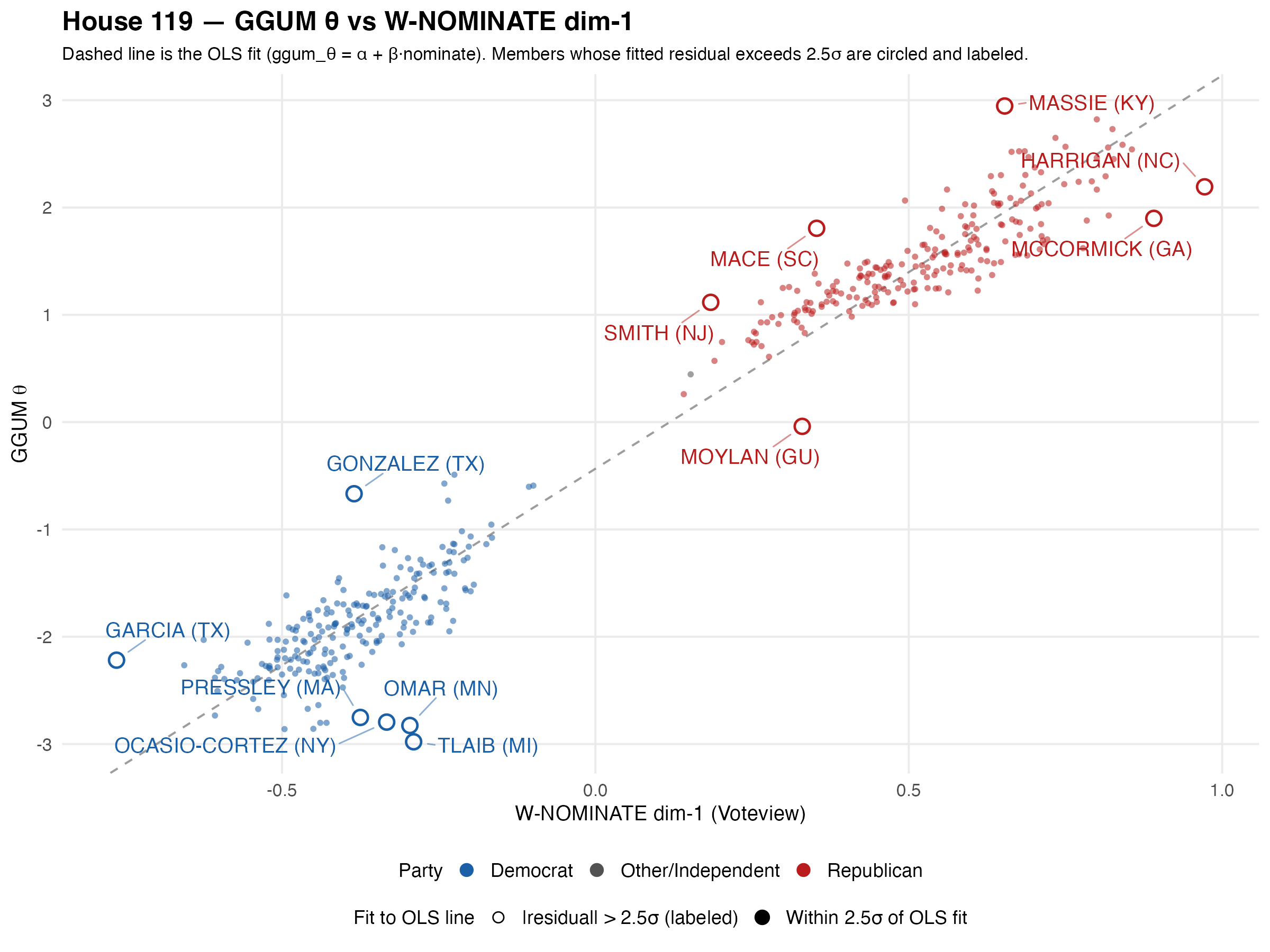
On the Democratic side, GGUM places Squad members (Tlaib, Omar, Ocasio-Cortez, Pressley) further left than W-NOMINATE; on the Republican side, Freedom Caucus members (Massie, Mace, McCormick) move further right. Institutional conservatives (Harrigan, Chris Smith) and Blue Dog Democrats (Vicente Gonzalez) stay closer to the party line. These distinctions emerge once vote-no-from-the-left and vote-no-from-the-right are allowed to look different from ordinary party-line voting.
Known limitations
For some members in some Congresses, the GGUM estimates may not make more sense than traditional models such as W-NOMINATE. The Senate Majority Leader is the one systematic case: the procedural voting that comes with the leadership role distorts the estimate, and we have excluded Harry Reid from the fit for the 110th, 111th, and 114th Senates (his rows carry ggum_flag = procedural_role). For other members, we flag individual placements that differ from what the member’s established political reputation might lead a reader to expect; these appear with ggum_flag = review in the CSV and are listed on each affected chamber’s sub-page under “Placements worth a second look.” We are drawing attention to these cases, not alleging error.
Codebook
| Column | Description |
|---|---|
icpsr | ICPSR member ID (joins to Voteview) |
bioname | Member name (LAST, First) |
party_code | 100 = Democrat, 200 = Republican, other = third-party / independent |
state_abbrev | Two-letter state code |
nominate_dim1 | W-NOMINATE first dimension (from Voteview, included for comparison) |
nominate_dim2 | W-NOMINATE second dimension (from Voteview) |
ggum_theta | GGUM posterior mean theta |
ggum_theta_sd | Posterior standard deviation of GGUM theta |
ggum_psrf | Gelman-Rubin PSRF across chains (close to 1.0; flagged above 1.1) |
ggum_flag | Empty by default; procedural_role if excluded from the fit (NA theta); review if the placement has a chamber-specific caveat |
All other Voteview member columns pass through unchanged.
Citation
If you use these estimates, please cite the paper:
Duck-Mayr, JB and Montgomery, JM (2023). Ends Against the Middle: Measuring Latent Traits When Opposites Respond the Same Way for Antithetical Reasons. Political Analysis 31(4): 606-625. doi:10.1017/pan.2022.33
Acknowledgments
We thank Voteview (voteview.com) for the roll-call and member metadata. Estimation used the bggum R package (github.com/duckmayr/bggum).
The prose on this page and the chamber sub-pages was drafted with Anthropic’s Claude Opus 4.7, with chamber-by-chamber plausibility audits conducted by Claude Sonnet 4.5 subagents. The author edited and reviewed throughout.